Florence Small Group Tours: What "Small Group" Really Means (2026)
"Small group tour" has no legal definition in Italy, so operators use it for anything from 8 people to 40. This guide explains what group size actually changes inside a Florence museum, how to check an operator’s real cap before you book, and what ours are.
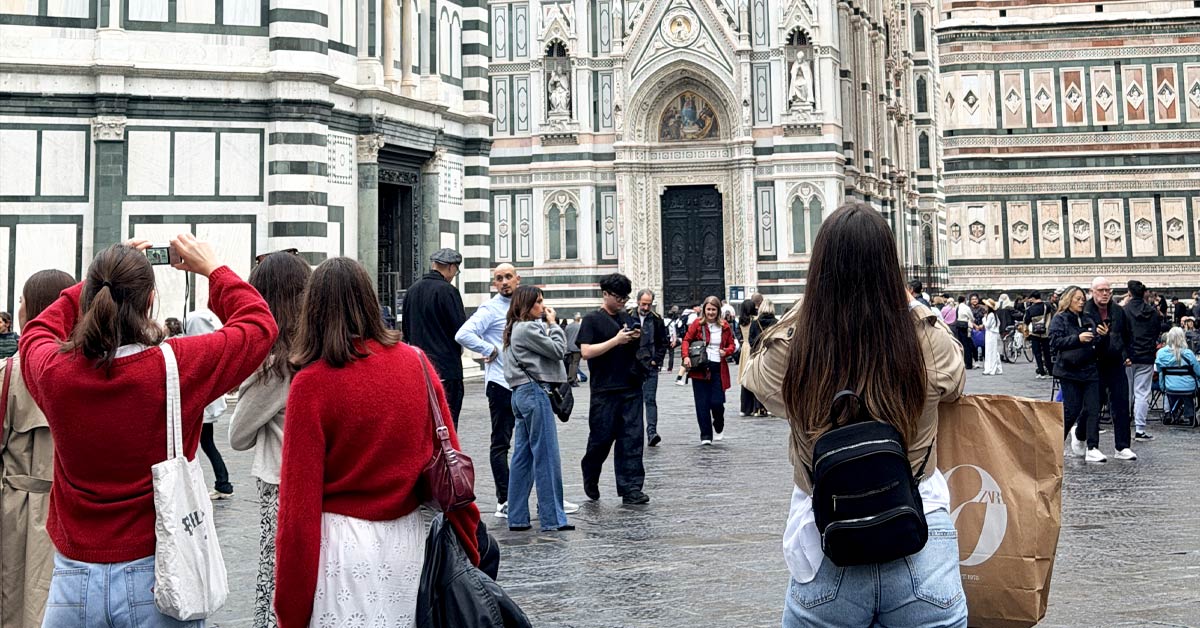
"Small group tour" is one of the least regulated phrases in travel. There is no legal definition, no industry standard, and no requirement to publish a number. That leaves the phrase doing a lot of work in marketing copy while meaning almost nothing on the ground.
This guide explains what group size actually changes inside a Florence museum, how to check a company's real cap before you book, and what our own numbers are.
What is a small group tour in Florence?
The confusion is deliberate
Because "small group" has no legal definition, a Florence operator can advertise a tour of 30 people as small group and break no rules. In practice, tours sold under that label in Florence fall into roughly four bands:
- Private: your party only
- Genuinely small: up to about 10 people
- Nominally small: 15–25 people
- Large group, small-group marketing: 25–40 people
A booking page that says "small group" without a number is telling you it is in one of the last two bands. Operators in the first two publish the figure, because it is the thing they are selling.
Our caps, published
We run a maximum of 10 travellers on our shared departures, and 9 on the Uffizi Gallery tour — the Uffizi corridors are narrow and the gallery's own timed-entry slots make a smaller group work better. Private tours are your party alone.
The exact cap appears on every tour page on this site, next to the price. If you are comparing us with another operator and cannot find their number in the same place, that difference is the point of this article.
Small group vs large group: what actually changes
Inside the museum
The difference is not comfort. It is whether you can see and hear the thing you paid to see and hear.
In a group of 10 (our tours):
- The guide speaks at conversational volume; no radio headsets needed in most rooms
- Everyone can stand within a few metres of the painting being discussed
- Questions get answered when you ask them, not saved for the end
- The group reassembles in seconds, not minutes
In a group of 20–30:
- Headsets are mandatory, which means you hear the guide but cannot easily talk back
- The people at the back look at the backs of the people at the front
- One or two confident travellers absorb most of the guide's attention
- Every transition between rooms costs the group several minutes
In the Uffizi, when a guide points at a detail in Botticelli's Birth of Venus — the wind gods on the left, the deliberate anatomical impossibility of Venus's neck — a group of nine can all position themselves to see it. A group of twenty-five takes turns, or takes the guide's word for it.
Skip-the-line is not one thing
Both a 10-person and a 30-person tour can honestly advertise skip-the-line entry, because both hold pre-booked timed tickets. What differs is what happens after the reservation desk.
Security screening is per person. Ticket scanning is per person. Gathering a group after the cloakroom is per person. A large group spends that time at every threshold; a small one does not. Neither operator is lying about skipping the line — the bottleneck simply moves from the public queue to your own group's logistics.
Guides behave differently
This is the part that is hard to quantify and easy to notice. A guide with ten people can read the group: notice who is lost, change the explanation, follow an interesting question somewhere unplanned. A guide with thirty is delivering a script, because a script is the only thing that survives that many people and a headset.
What you lose in a large group
Questions. In a group of ten, you ask when you think of it. In a group of thirty, you either don't ask or you queue for the guide's attention at the end, by which point you have left the room.
Sightlines. Renaissance painting rewards standing close. Much of what a guide will tell you about the Primavera or the Annunciation concerns detail you need to be within a couple of metres to see.
Pace. A small group can slow down in front of something that grabs it and move briskly past something that doesn't. A large group runs to a fixed timetable, because it has to.
Time. Every logistical step — entry, security, regrouping, the cloakroom — scales with headcount. The advertised tour length is the same; the amount of it spent looking at art is not.
The economics
What the price difference buys
Florence tour pricing is fairly predictable once you know the group size:
| Type | Typical price | Group size |
|---|---|---|
| Large group tour | €30–45 | 25–40 |
| Small group tour | €50–70 | up to 10 |
| Private tour | €200+ total | your party |
Our Uffizi Gallery small-group tour includes admission and takes a maximum of 9 travellers; see the tour page for the current price. Our range runs from skip-the-line entry tickets to private tours priced per group.
The gap between a large-group tour and a small-group tour is not margin. A guide's time and the venue's admission cost roughly the same whichever tour you are on — the difference is how many people that cost is divided between. Fewer people means a higher price per head. That is the whole mechanism, and any operator claiming to deliver genuinely small groups at large-group prices is doing one of those two things differently from how they describe it.
When a large group is the right choice
Not every visit needs a small group. A large group tour is a sensible choice when you mainly want guaranteed entry and orientation, when you are on a tight budget, when you are comfortable with a headset and a fixed pace, or when you already know the collection and want access more than interpretation.
We would rather you booked the right tour than our tour.
How to check a company's real group size
Warning signs
- The words "small group" appear repeatedly but no number does
- The number is given as a range with a high ceiling — "8 to 25 people"
- The maximum appears only in the terms and conditions, not on the booking page
- The price is far below other small-group tours for the same museum
- The company also runs large-group departures on the same product
Good signs
- The maximum is stated on the tour page, next to the price
- Different tours have different, specific caps, because different venues allow different things
- The company will confirm the cap in writing before you pay
- The cancellation and refund terms are published on the site, not only in the checkout
Ask before booking
- What is the maximum number of travellers on this specific departure?
- Is that a cap, or a target you may exceed?
- Will headsets be used, and if so, why?
- What happens if fewer people book — does the tour still run?
- What is the refund policy if you cancel?
Any operator running genuinely small groups can answer all five in one email. We answer them at contact@florencewithlocals.com, usually within a few hours.
How we work
We are a licensed Florence tour operator — Florence With Locals S.r.l., registered in Florence — and we run our own tours rather than reselling someone else's. Our guides are licensed by the Region of Tuscany and live in the city.
We publish the cap on every tour page because it is checkable, and because a number you can check is worth more than an adjective you cannot.
We do not run large-group departures. That is a deliberate limit on how much we can sell, and it is why our prices sit where they do.
Types of small group tour in Florence
Museum tours
Uffizi Gallery small group tour — maximum 9 travellers, skip-the-line admission included. Botticelli, Leonardo, Michelangelo, and the Medici collection that started the whole idea of a public gallery.
Accademia Gallery and David — maximum 10 travellers. Michelangelo's David, the unfinished Prisoners, and the reason the statue is far stranger up close than in photographs.
Uffizi and Accademia combination — both major collections with the same guide, which is the version most first-time visitors want.
Walking tours
The historic centre, the Duomo complex, and the parts of the city where the Renaissance actually happened rather than where it is displayed. Group size matters differently outdoors — the constraint is noise and traffic rather than sightlines, but the effect on questions and pace is the same.
Day trips
Chianti, Siena and San Gimignano. On a day trip, group size mostly determines how long every stop takes, and whether the itinerary can flex when something is unexpectedly worth staying for.
See all our Florence tours — every one lists its cap and its price.
Booking
When to book
Uffizi and Accademia timed slots go first for morning entry in high season. In spring and autumn, a week ahead is usually enough. In July and August, and over Easter, book earlier — the constraint is the museum's slot availability, not ours.
Our terms
Free cancellation up to 24 hours before the start time, full refund. Inside 24 hours, and for no-shows, we cannot refund, because museum admission has already been reserved in your name. If we cancel for any reason, you get everything back.
Under Italian consumer law (art. 59(1)(n), D.lgs. 206/2005) the 14-day right of withdrawal does not apply to leisure services booked for a specific date, so the terms above are what governs. They are set out in full in our Terms & Conditions.
Frequently asked questions
Is a small group tour better than a private tour?
Different, not better. A private tour gives you complete control of pace and content and costs more. A small group gives you most of the access at a fraction of the price, and some people prefer having other travellers to talk to. If you have a specific interest you want followed for two hours, book private.
What if I'm travelling alone?
Small group tours suit solo travellers well — you are with a handful of people rather than lost in a crowd, and guides can include you in the conversation. There is no single supplement on our shared departures.
Are they suitable for families?
Yes, and the smaller cap helps: children can stand at the front, and a guide with ten people can adjust when attention flags. For children under about six, a private tour is usually easier for everyone.
Is 10 people really different from 20?
Yes, and the difference is not linear. Somewhere around a dozen people, a guide stops having a conversation and starts giving a presentation — headsets appear, questions get deferred, and the group starts moving at the speed of its slowest transition. That threshold, not any particular number, is what matters.
How do I know the tour won't exceed the stated maximum?
The cap on the tour page is the cap in the booking system — once the seats are sold, the departure closes. If you want it confirmed in writing before you pay, email us and we will confirm it.
Do small group tours actually skip the line?
Ours hold pre-booked timed admission, so you enter at your slot rather than joining the general queue. Group size then determines how quickly the group clears security and regroups inside.
What happens if it rains?
Museum tours run regardless. Walking tours run in light rain and are rescheduled or refunded if conditions make them unsafe or pointless.
The short version
Group size is the single most useful number on a tour listing, and it is the number most often left out. Ours are 10 on shared departures and 9 at the Uffizi, published next to the price on every tour page.
If you are comparing operators, ask each one for their maximum in writing. The answer, and how quickly it comes, tells you most of what you need to know.
Book a guided tour in Florence
We are a licensed Florence tour operator running small-group museum tours with local guides. Browse our tours.
Florence With Locals S.r.l. — Via Taddea 35/R, 50123 Firenze (FI), Italy · P.IVA / VAT IT07564730484 · Registro Imprese di Firenze 07564730484 · REA FI-712305 · SCIA – Agenzia di viaggi e tour operator (ATECO 79.11) — SUAP Comune di Firenze, prot. 07564730484-23072026-0853.
contact@florencewithlocals.com · +39 327 249 1282 · PEC withlocals@pec.it