Accademia Gallery Florence Guide 2026: Tickets, Hours & What to See
Everything you need to know about visiting the Accademia Gallery in Florence: Michelangelo's David, 2026 tickets and opening hours, how to avoid the long lines, and the hidden masterpieces most visitors miss.
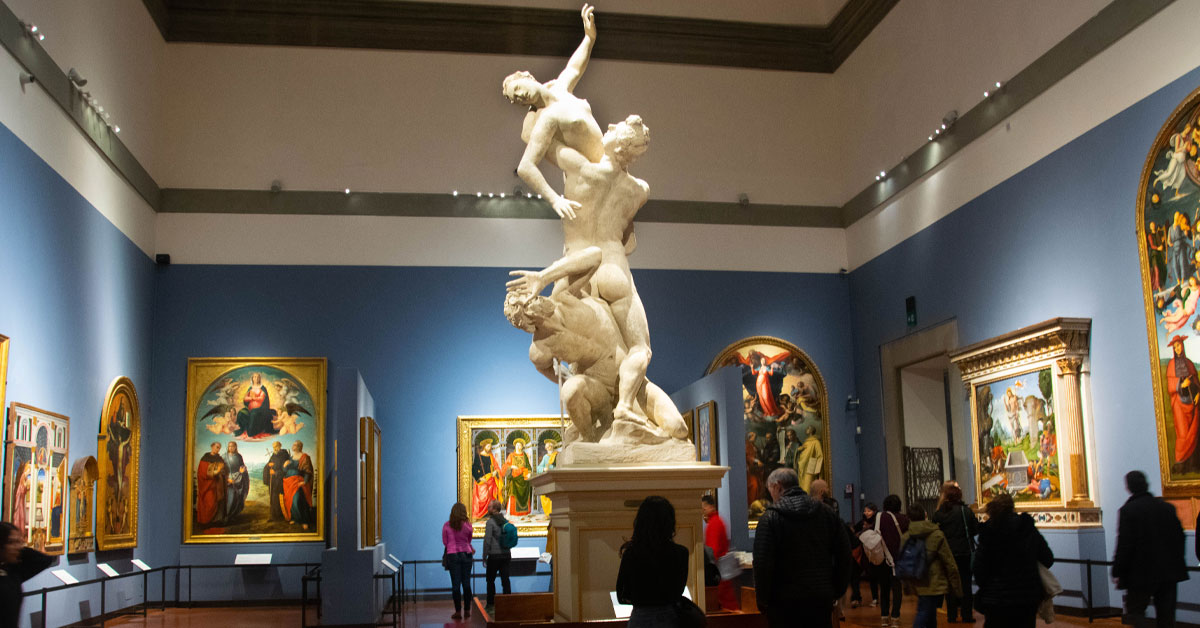
The Accademia Gallery (Galleria dell'Accademia) in Florence is home to one of the world's most iconic sculptures: Michelangelo's David. But this renowned museum offers far more than just David—though he alone is worth the visit. This comprehensive guide will help you make the most of your Accademia Gallery experience, from skip-the-line strategies to hidden masterpieces you shouldn't miss.
What is the Accademia Gallery?
The Galleria dell'Accademia is Florence's second-most visited museum (after the Uffizi), attracting over 1.5 million visitors annually. Founded in 1784 as a gallery for art students at the nearby Academy of Fine Arts, it has evolved into one of Italy's most important museums.
The gallery's star attraction is Michelangelo's David, which was moved here in 1873 to protect it from the elements after standing in Piazza della Signoria for 369 years. Today, the museum houses an impressive collection of Renaissance art, including seven sculptures by Michelangelo, medieval paintings, and 19th-century works.
Quick Facts:
- Location: Via Ricasoli, 58-60, 50129 Florence
- Founded: 1784
- Annual Visitors: 1.5 million+
- Most Famous Work: Michelangelo's David (1504)
- Average Visit Time: 90-120 minutes
- Best Known For: Renaissance sculpture and painting
The History of the Accademia Gallery
Origins as an Art School (1784)
The Accademia Gallery was established in 1784 by Grand Duke Pietro Leopoldo as a teaching museum for students of the nearby Academy of Fine Arts of Florence. The gallery's original purpose was to provide aspiring artists with examples of great art to study and copy—a common practice in Renaissance and post-Renaissance art education.
David Arrives (1873)
The gallery's transformation into a major tourist destination occurred in 1873 when Michelangelo's David was moved here from Piazza della Signoria. The statue had stood outdoors for 369 years and was suffering from weathering and damage. A special tribune was designed specifically to house and display David, creating the dramatic presentation visitors see today.
Expansion and Modern Era
Throughout the 20th century, the gallery expanded its collections, acquiring important Renaissance paintings, plaster models from 19th-century sculptors, and additional works by Michelangelo. Today, it stands as a testament to Florence's artistic heritage, particularly its sculptural tradition.
Michelangelo's David: Everything You Need to Know
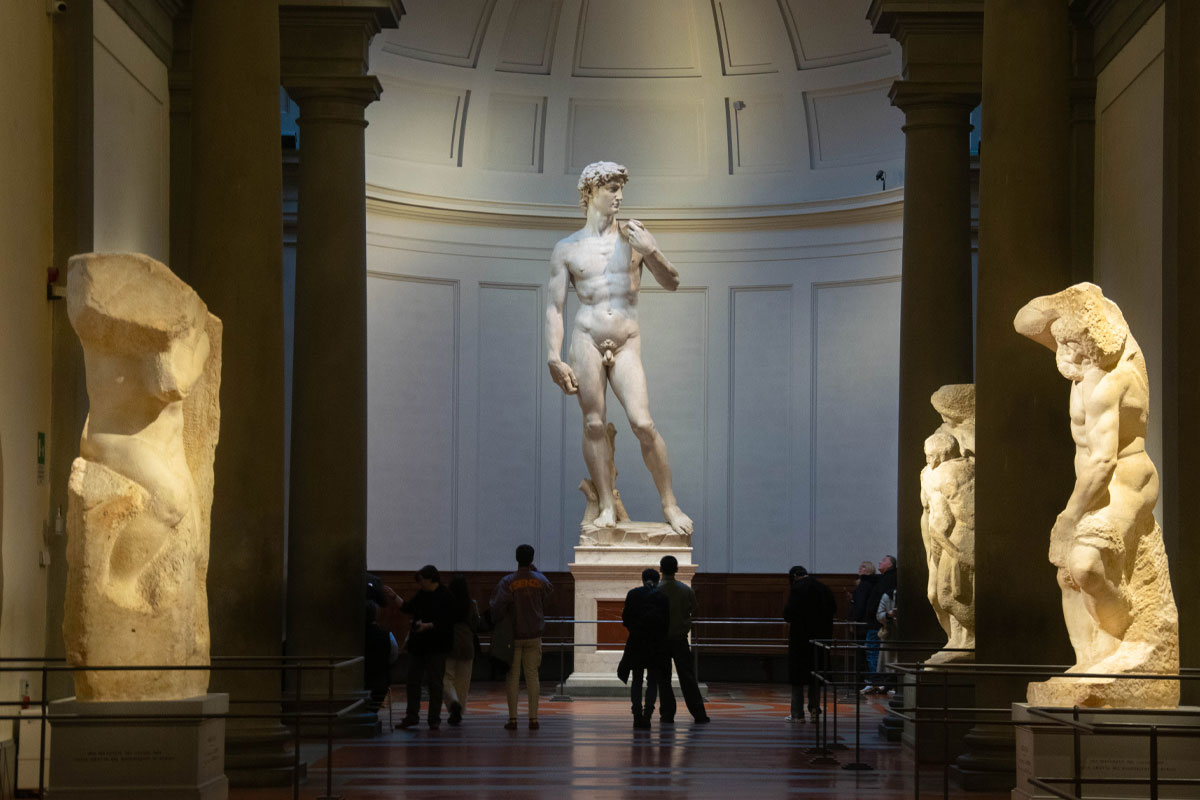
The magnificent David stands 17 feet tall in the Accademia Gallery's tribune hall, illuminated by natural skylight.
The Creation Story
Between 1501 and 1504, a 26-year-old Michelangelo carved David from a single block of white Carrara marble. The block had been abandoned for 25 years after two other sculptors (Agostino di Duccio and Antonio Rossellino) deemed it too difficult to work with due to its unusual proportions and existing drill holes.
Michelangelo saw potential where others saw impossibility. Working in secret for three years, he created not just a biblical hero, but a symbol of the Florentine Republic itself.
Biblical Context: David vs. Goliath
The sculpture depicts the biblical hero David before his battle with the giant Goliath. Unlike traditional representations showing David triumphant with Goliath's severed head, Michelangelo captures the moment of contemplation and determination before the battle—a psychological portrait rather than a victory scene.
Fascinating Facts About David
Size and Scale:
- Height: 17 feet (5.17 meters)
- Weight: 6 tons (12,478 pounds)
- Marble: Single block from Carrara
- Carving Time: 3 years (1501-1504)
The "Big Hands" Controversy:
David's hands are deliberately oversized—about 10% larger than anatomically correct. Scholars debate whether this was:
- A practical consideration (originally meant for high placement on Duomo)
- Symbolic (emphasizing David's strength and destiny)
- A perspective trick (hands appear smaller from below)
- Michelangelo's artistic choice (emphasizing tension and power)
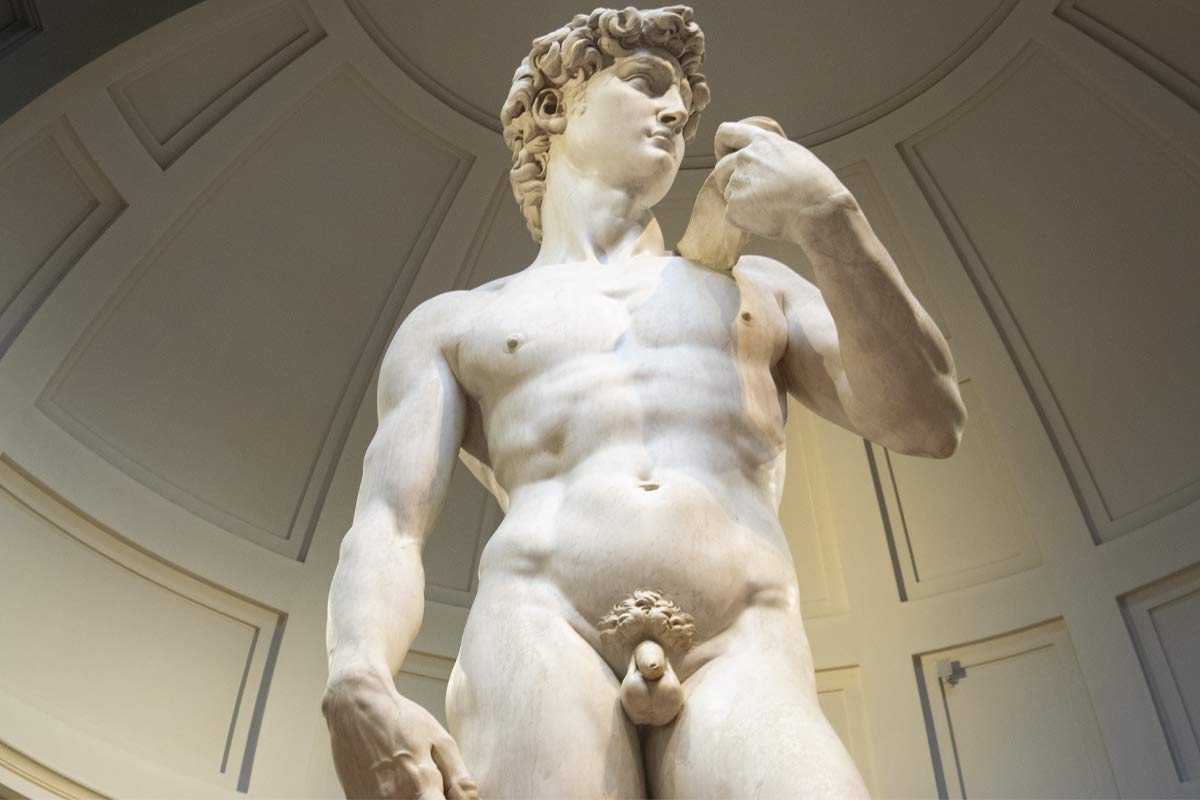
David's famous oversized hands showcase Michelangelo's incredible attention to anatomical detail, including veins and tendons carved in marble.
The "Murder Marble" Legend:
The marble block used for David had a dark history. It was originally quarried in 1464 and nicknamed "the murder marble" because the quarry workers who extracted it were allegedly murdered shortly after. The block sat abandoned for decades, supposedly cursed, until young Michelangelo fearlessly claimed it.
Why is David Nude?
Renaissance artists looked to classical Greek and Roman traditions, where nude male figures represented heroic virtue and divine perfection. David's nudity connects him to the classical heroes of antiquity and emphasizes his humanity and vulnerability before facing Goliath.
David's Intense Gaze:
Look closely at David's face. His furrowed brow, flared nostrils, and tense expression capture the moment of concentration before battle. His gaze is directed toward Rome—traditionally Florence's political rival—making David a symbol of Florentine independence and Republican values.
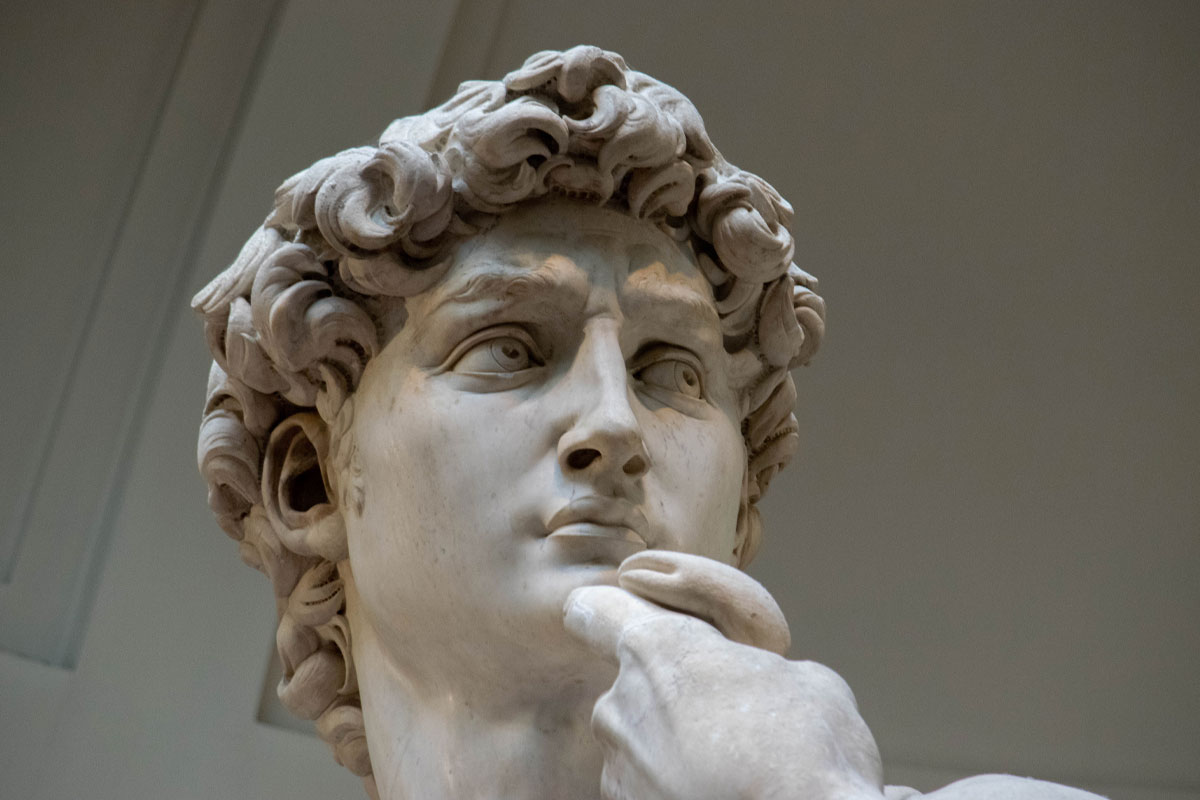
David's intense gaze and furrowed brow capture the psychological moment before facing Goliath.
How to View David
The statue stands at the end of a long corridor in a purpose-built tribune with a skylight designed to illuminate him from above. As you approach through the gallery, you'll see David gradually revealed—a dramatic presentation that heightens the impact.
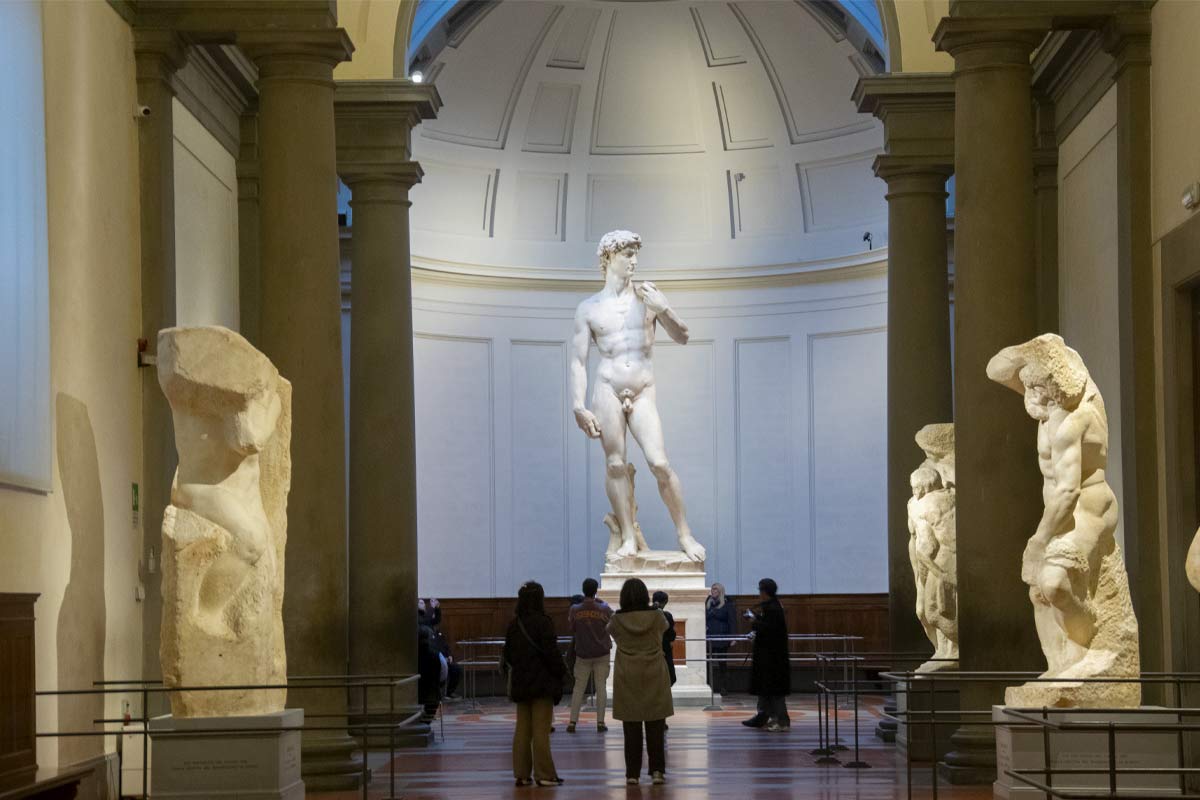
The specially designed tribune with its skylight creates dramatic natural lighting that illuminates David from above.
Best Viewing Strategy:
- First View: Approach from the entrance and take in the full impact of seeing David for the first time
- Close Examination: Move close to observe the incredible marble details—veins, muscles, hair
- Side Views: Walk around to the left and right to see how David's posture changes
- Back View: The rear view reveals Michelangelo's incredible anatomical knowledge
- Distant View: Step back to appreciate the full composition and proportions
Photography Tips:
- Flash photography is prohibited (damages the marble)
- Best angle: Slightly left of center, from about 15 feet away
- Avoid: Direct front view (can appear flat), extreme close-ups (lose context)
- Tip: Visit early morning for fewer people in your shots
What Else to See at the Accademia Gallery
While David is the star, the Accademia houses many other treasures worth your attention:
Michelangelo's Prisoners (The Slaves)
Located in the corridor approaching David, these four unfinished sculptures (circa 1530) are arguably as fascinating as David himself. The "Prisoners" or "Slaves" appear to be struggling to emerge from the rough marble blocks.
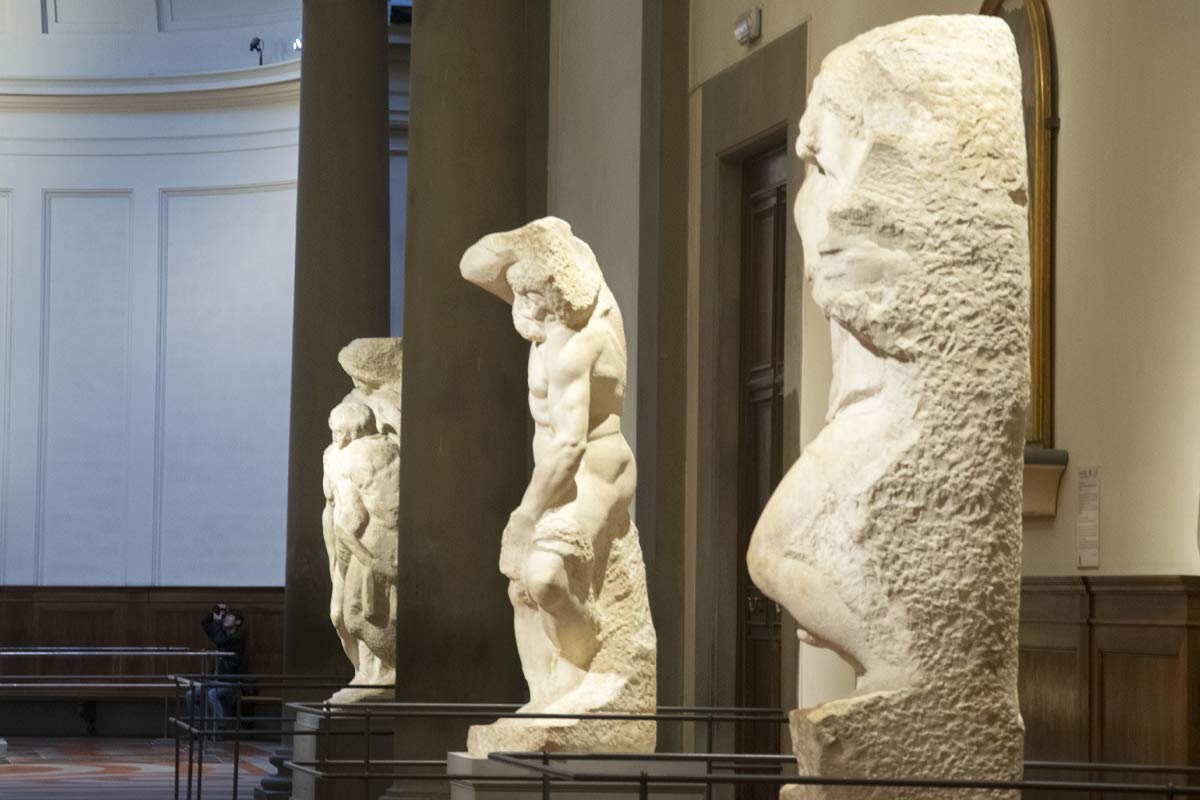
The four Prisoners or Slaves show Michelangelo's concept of "liberating" figures from marble, frozen in their emergence from the stone.
The Four Prisoners:
- Young Slave
- Atlas Slave (seems to hold up the world)
- Bearded Slave
- Awakening Slave (most finished)
These were originally intended for the tomb of Pope Julius II—a project Michelangelo never completed. The unfinished state provides unique insight into Michelangelo's process and his concept of "liberating" figures from the marble.
Why They're Unfinished:
Michelangelo believed figures already existed within the marble, waiting to be freed. The rough, partially carved surfaces show his working method: he carved from the front forward, gradually revealing the figure. Some scholars suggest he left them incomplete intentionally, representing the human soul's struggle to free itself from material constraints.
St. Matthew (1506)
Another unfinished Michelangelo sculpture, St. Matthew shows the artist's incredible ability to convey motion and energy in static marble. Like the Prisoners, the figure seems to be emerging from the stone.
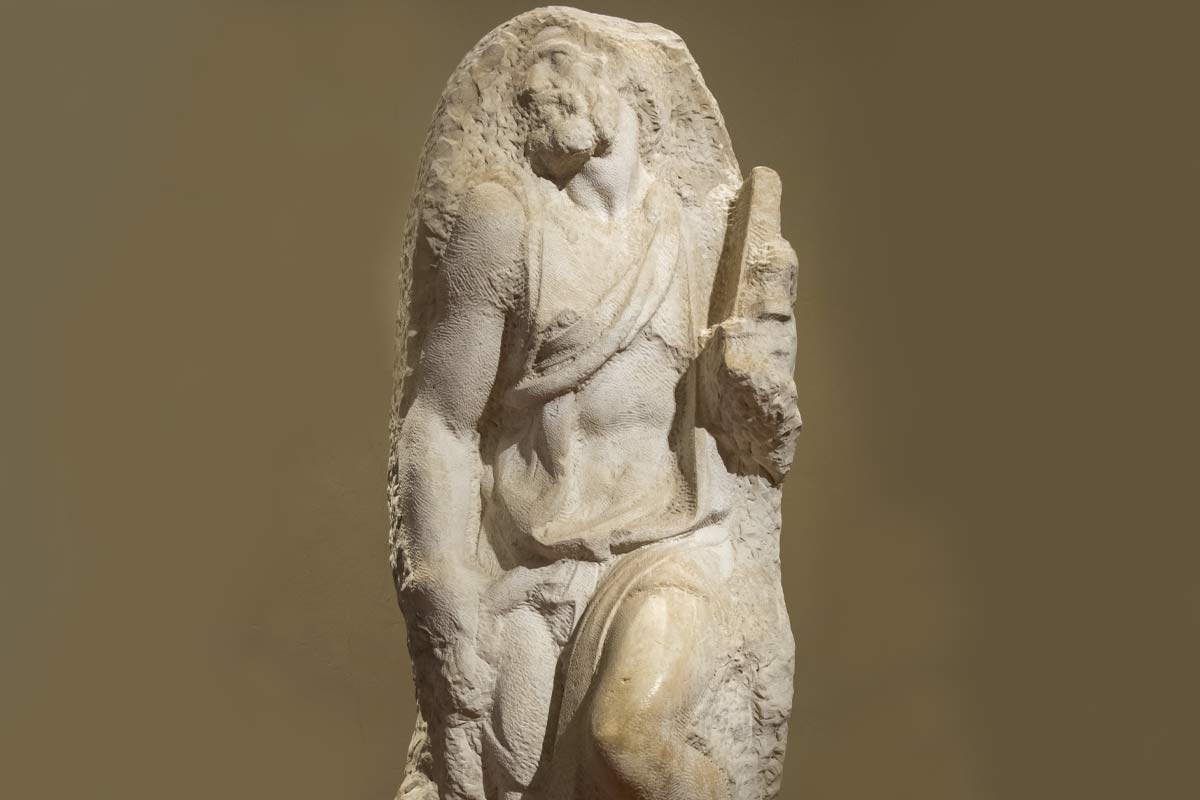
St. Matthew, another unfinished masterpiece, demonstrates Michelangelo's technique of carving from front to back.
Pietà di Palestrina
Attributed to Michelangelo (though debated), this marble pietà depicts Mary holding the dead body of Christ. The rough, unfinished surface creates emotional intensity.
The Gipsoteca
On the upper floor, the Gipsoteca houses plaster models by 19th-century sculptor Lorenzo Bartolini. These models reveal the sculptural process and showcase Romantic-era artistry.
Medieval and Renaissance Paintings
Florentine Gothic Paintings:
The museum's collection includes stunning gold-background religious paintings from the 13th-15th centuries, showcasing the transition from Byzantine traditions to Renaissance realism.
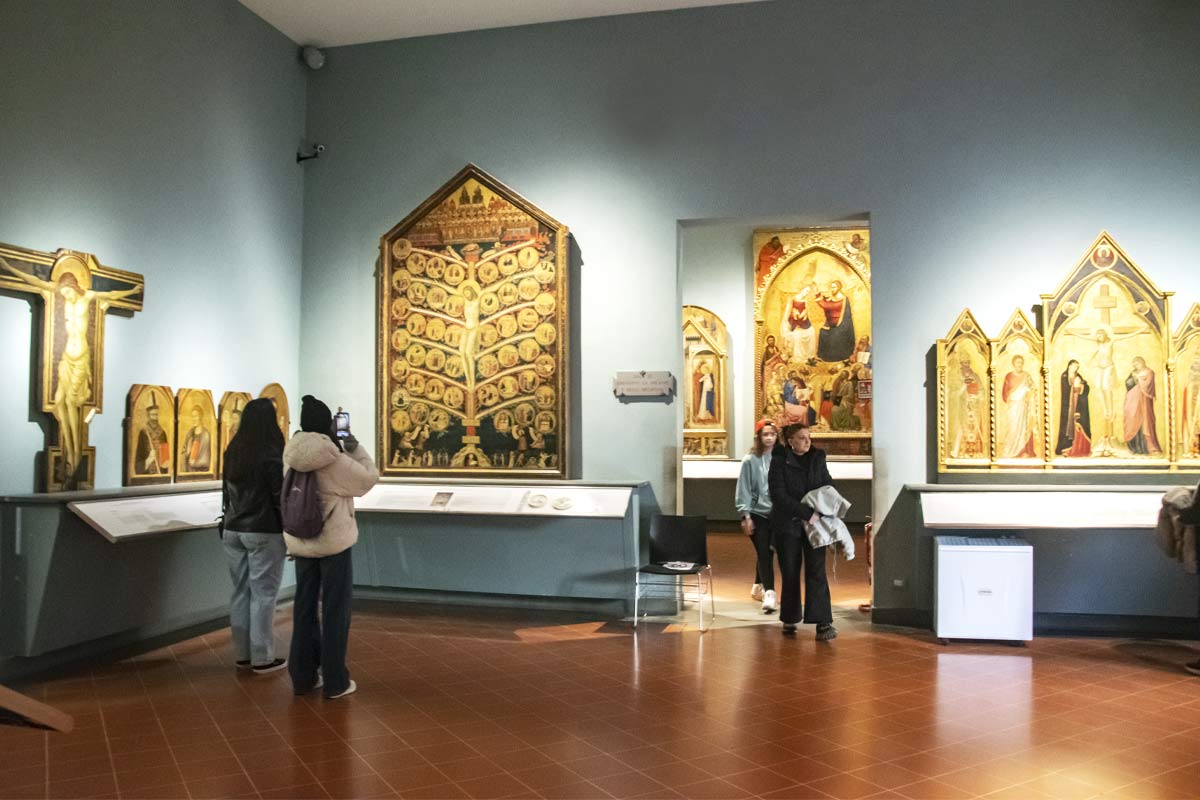
The museum's collection of gold-background medieval paintings showcases the evolution from Byzantine to Renaissance styles.
Notable Works:
- Madonna and Child by Bernardo Daddi
- The Annunciation by Lorenzo Monaco
- Various works from the Florentine School
Museum of Musical Instruments
In a separate section, you'll find an impressive collection of historic instruments, including several made by Antonio Stradivari. This collection is often overlooked but fascinating for music lovers.
Russian Icon Collection
A small but exquisite collection of Russian Orthodox icons from the 14th-17th centuries offers a rare glimpse into Eastern Christian art traditions.
How Long to Spend at the Accademia Gallery?
Recommended Visit Time: 90-120 minutes
Quick Visit (60 minutes)
If you're short on time or primarily interested in seeing David:
- 10 min: Admiring the Prisoners corridor
- 30 min: David (from all angles, photos)
- 20 min: Highlights of painting collection
Standard Visit (90 minutes)
The ideal timeframe for most visitors:
- 15 min: Prisoners and approach to David
- 30 min: David (thorough viewing, photos)
- 30 min: Painting galleries
- 15 min: Musical instruments or additional galleries
Comprehensive Visit (2 hours)
For art enthusiasts:
- 20 min: Prisoners with careful observation
- 40 min: David (including reading information panels)
- 40 min: Full painting collection
- 20 min: Musical instruments, Russian icons, Gipsoteca
Tip: The museum is compact compared to the Uffizi. Even 90 minutes allows for a thorough visit without rushing.
Skip-the-Line Strategies
The Accademia Gallery can have long waits without a reservation: they can exceed 1-2 hours in high season (April-October) and can still be long in shoulder seasons. Here's how to avoid the lines:
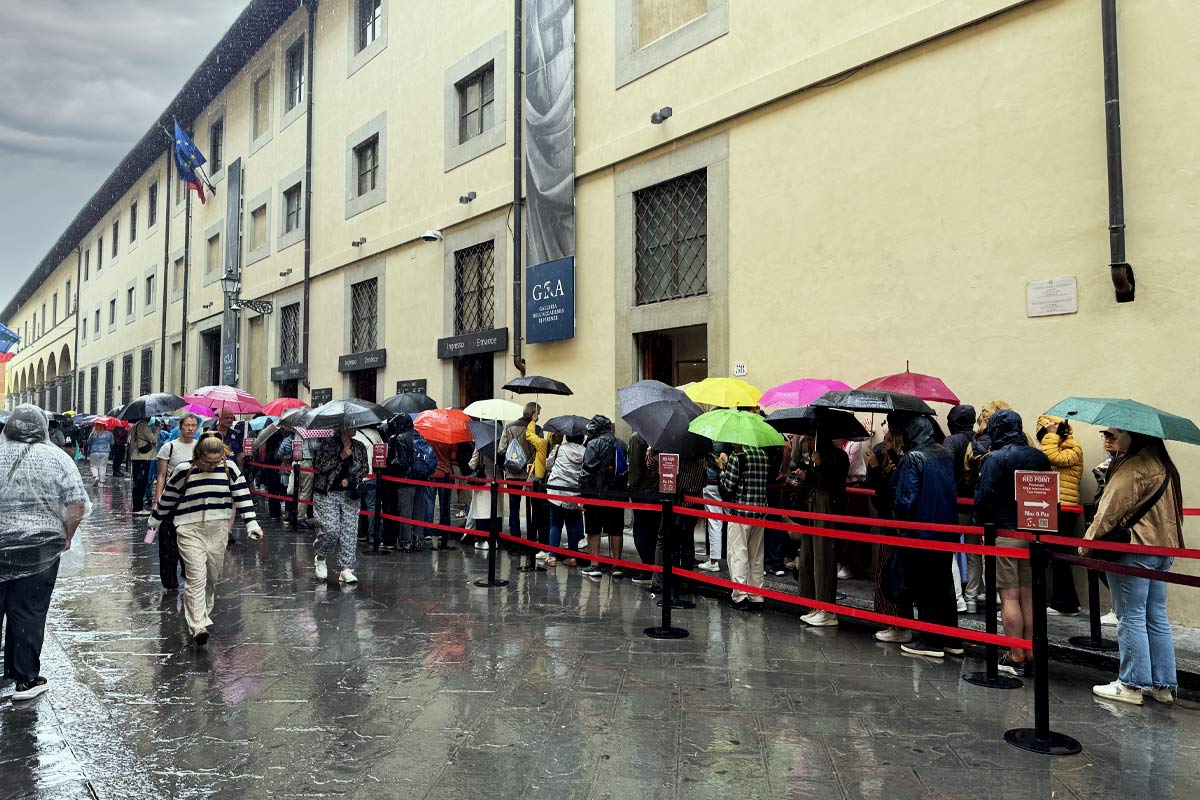
Long queues are common at the Accademia Gallery entrance, especially from May to September - plan ahead to skip the wait.
Option 1: Pre-Book Skip-the-Line Tickets
Pros:
- Guaranteed entry at specific time
- Skip the general admission line
- Flexibility to explore alone
- Only a €4 booking fee on top of the €20 ticket (€24 total)
Cons:
- No guide (miss context and stories)
- Must figure out what you're seeing
- Easy to overlook important works
Where to Book:
- Official museum website (galleriaaccademiafirenze.it)
- Our skip-the-line tickets (includes support)
Option 2: Small Group Guided Tour
Pros:
- Skip-the-line entry
- Expert guide provides context and stories
- Learn about works you'd otherwise miss
- Small groups (max 10 people) feel personal
- Questions encouraged
Cons:
- Set itinerary and pace
- Slightly more expensive than DIY
Our Recommendation:
For first-time visitors, a small group tour provides significantly more value. You'll learn stories and details that transform your visit from "saw David" to "understood Renaissance art."
Option 3: Visit at Strategic Times
If you must visit without pre-booking:
Best Times (Shorter Lines):
- First entry: 8:15am opening (usually the shortest wait of the day)
- Late afternoon: After 4:30pm (usually shorter than at midday; last entry 6:20pm)
- Off-season: November-February (excluding Christmas)
- Avoid: June-August, Easter week, all summer weekends

Plan your visit strategically: early morning and late afternoon offer the shortest wait times.
Line Hack:
The line snakes down Via Ricasoli. If you see it extending beyond Via Guelfa intersection (about 200 meters), expect a long wait (it can exceed 1-2 hours in high season). Arriving before the 8:15am opening gives you the best chance of a short line.
Option 4: Florence Pass
If visiting multiple museums, the Firenze Card or similar passes include Accademia:
- Firenzecard: €85, valid 72 hours from your first museum entry; includes entry and booking at the Uffizi and the Accademia (Firenzecard Restart, €28, extends it to 5 days)
- Worth it if: Visiting Uffizi + Accademia + Palazzo Pitti + 2-3 others
Best Times to Visit the Accademia Gallery
By Time of Day
Best: 8:15-9:30am (Opening)
- Shortest lines
- Fewer crowds around David
- Natural light at its best in the tribune
- Can take photos with fewer people
Good: 4:30-6:20pm (Late Afternoon)
- Lines thin out significantly
- Lighting still good in winter
- Museum less crowded
- Last entry is 6:20pm (museum closes 6:50pm)
Avoid: 10:00am-3:00pm
- Peak tour bus arrival times
- Longest waits (can exceed 1-2 hours)
- Most crowded around David
- Difficult to take photos
By Season
Best: November-March (except Christmas)
- Fewest tourists
- Reasonable lines even without pre-booking
- Can visit spontaneously
- Lower accommodation costs
Good: April-May, September-October
- Beautiful weather
- Moderate crowds
- Pre-booking essential
- Spring blooms or fall colors
Challenging: June-August
- Peak tourist season
- Longest waits of the year (can exceed 1-2 hours)
- Very crowded around David
- Pre-booking absolutely essential
- Hot weather (museum is climate-controlled, but lines are outdoors)
By Day of Week
Best: Tuesday, Wednesday, Thursday
- Fewer tour groups
- More locals than tourists
- Restaurants less busy nearby
Closed: Monday
- The Accademia is closed on Mondays (and so is the Uffizi)
- Plan your museum days around it
Avoid: Saturday, Sunday
- Weekend crowds
- Local Italian visitors mix with international tourists
Small Group Tours vs. Self-Guided Visits
Self-Guided Visit
Best For:
- Repeat visitors
- Serious art students
- People who prefer setting their own pace
- Those on very tight budgets
What You'll Miss:
- Context about Michelangelo's life and techniques
- Stories behind the Prisoners
- Hidden details in David
- Understanding the religious paintings
- The "why" behind what you see
Estimated Cost:
- Tickets: €20 (€24 with a reserved time slot)
- Time in line: can exceed 1-2 hours in high season without a reservation
Small Group Guided Tour (Max 10 People)
Best For:
- First-time visitors
- Art enthusiasts wanting deeper understanding
- Anyone who values learning over just "seeing"
- People who want to skip lines
What You'll Gain:
- Expert local guide's insights
- Stories that bring art to life
- Details you'd never notice alone
- Ability to ask questions
- Context that transforms your visit
- Skip the long entrance lines
Estimated Cost:
- Tour: see the tour page for current prices (reserved entry included)
- Time in line: minimal (reserved entry)
Value Comparison:
Self-guided ticket (€24 with reservation) + a possible long wait without one + missing context = Less satisfying experience
Small group tour + reserved entry + expert insights = Deeper, more memorable experience
Our Tours:
We offer small group Accademia tours limited to 10 people, ensuring personal attention and the ability to ask questions. Our local guides are passionate Florentines who share stories that transform your visit.
Practical Information

Map of the Accademia Gallery showing the tribune (David), Prisoners corridor, and other main sections.
Opening Hours 2026
- Tuesday-Sunday: 8:15am - 6:50pm (last entry 6:20pm, 30 minutes before closing)
- Closed: Mondays, January 1, December 25
Note: Hours occasionally change for special events or restoration. Always check the official website before your visit.
Ticket Prices 2026
- Full Price: €20 (since 1 February 2026)
- Reduced: €2 (EU citizens 18-25 years)
- Free: Under 18, visitors with disabilities + one companion
- Reservation Fee: €4 for a reserved time slot (€24 total, highly recommended)
- First Sunday: Free admission (expect massive crowds—not recommended)
- Combined tickets (since 15 March 2026): 48-hour Accademia + Bargello €26; 72-hour ticket for all 6 museums of the group €38

Compare ticket options: regular entry, skip-the-line, guided tours - choose what's best for your visit.
How to Get There
Address:
Galleria dell'Accademia
Via Ricasoli, 58-60
50129 Florence, Italy
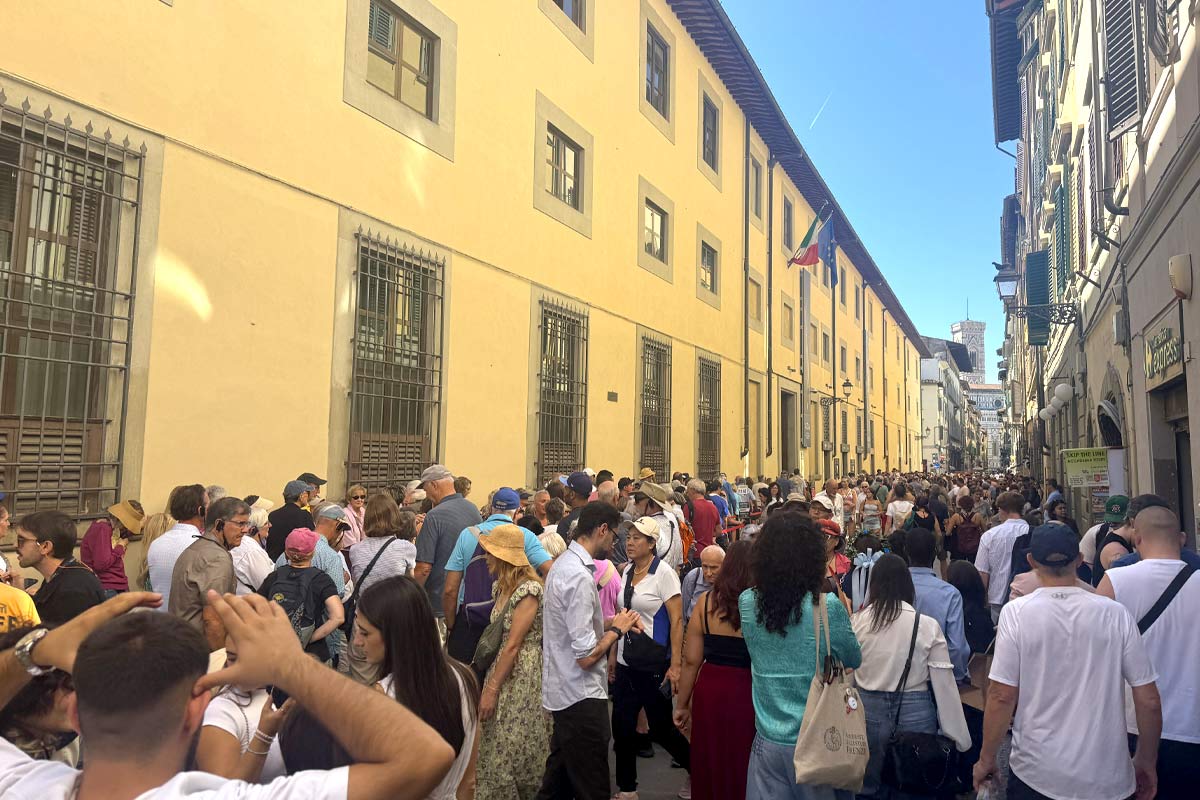
The Accademia Gallery entrance on Via Ricasoli, just a 5-minute walk north from the Duomo.
Walking:
- From Duomo: 5 minutes (400m) north on Via Ricasoli
- From Piazza della Signoria: 10 minutes (750m)
- From Santa Maria Novella station: 15 minutes (1.2km)
By Bus:
Lines C1, C2: Stop "Ricasoli" (directly outside)
Lines 6, 11, 14, 23: Stop "SS Annunziata" (2-minute walk)
Parking:
Garage Parterre (Via Madonna della Tosse) - 10-minute walk
What to Bring
Required:
- Valid ID for reduced tickets
- Reservation confirmation (email or printed)
- Comfortable shoes (marble floors)
Recommended:
- Water bottle (no food/drink in galleries, but allowed in entry area)
- Camera (no flash)
- Light jacket (climate-controlled, can be cool)
Not Allowed:
- Large bags or backpacks (free cloakroom available)
- Food and drinks in gallery
- Tripods or selfie sticks
- Flash photography
- Touching artwork
Accessibility
- Wheelchair accessible via ramps
- Wheelchair available on request
- Accessible bathroom
- Free entry for disabled visitors + companion
- Some areas require elevator access (ask staff)
Museum Shop
Located at exit, the gift shop offers:
- Quality art books and David reproductions
- Postcards and posters
- Children's books about art
- Small David replicas (various sizes and materials)
Recommended: The illustrated guide to the museum is excellent
Tours That Include the Accademia Gallery
Looking to visit the Accademia with expert guidance? We offer several small group tour options:
1. David & Accademia Gallery VIP Tour
Duration: 1 hour
Group Size: Maximum 10 people
Price: See the tour page for current prices
Includes:
- Skip-the-line entry
- Expert local guide
- David, Prisoners, and painting highlights
- Time for questions
2. Uffizi & Accademia Semi-Private Tour with Art Historian
Duration: 3.5 hours
Group Size: Maximum 9 people
Price: See the tour page for current prices
Includes:
- Reserved entry to both the Uffizi and the Accademia
- Art historian guide (tour in English)
- Uffizi masterpieces, then David and the Prisoners
- Gelato included
- Departures at 9:30am and 2:15pm
3. Accademia Gallery Skip-the-Line Tickets
Not a tour - tickets only
Price: See the tour page for current prices
Includes:
- Skip-the-line entry
- Self-guided visit
- Instant confirmation
Frequently Asked Questions
How long are the lines at the Accademia Gallery?
Without a reservation, waits vary widely with the season and time of day and can exceed 1-2 hours in high season, especially 10am-2pm in June-August. Early morning (8:15am opening) and late afternoon (after 4:30pm; last entry 6:20pm) usually have shorter lines. Booking a timed ticket (€20 + €4 booking fee) or taking a tour is the best way to avoid the wait.
Is the Accademia Gallery worth it?
Absolutely yes. Seeing Michelangelo's David in person is a once-in-a-lifetime experience. Photos cannot capture the sculpture's scale, presence, and stunning marble craftsmanship. The Prisoners provide fascinating insight into Michelangelo's creative process. Even if you're not an art enthusiast, David's cultural significance and beauty make this museum essential.
What should I see besides David?
Don't miss:
- Michelangelo's Prisoners - Four unfinished sculptures showing his process
- St. Matthew - Another unfinished Michelangelo work
- Gold-background medieval paintings - Beautiful religious art
- Musical instruments collection - Including Stradivari violins
Can I take photos of David?
Yes, photography is allowed, but flash is strictly prohibited as it damages the marble. Selfie sticks and tripods are not allowed. Be respectful of others trying to view and photograph the statue.
How far in advance should I book?
- Peak season (April-October): Book 1-2 weeks ahead minimum
- Shoulder season: 3-5 days ahead
- Winter: Can often book 1-2 days ahead
- Summer weekends: Book 2-3 weeks ahead
Last-minute bookings are sometimes available, but don't risk it during busy periods.
Is there a dress code?
No strict dress code, but:
- Comfortable walking shoes (marble floors)
- Modest clothing recommended (it's a museum)
- Shoulders and knees covered shows respect
- Avoid wearing backpacks (must check them)
Can I bring my bag?
Small bags are allowed, but backpacks and large bags must be checked at the free cloakroom. Security screening at entrance may require bag search. Travel light if possible.
Is the Accademia Gallery suitable for children?
Yes, but:
- Best for ages 10+ (younger children often get bored)
- Explain David's significance beforehand
- Keep visits to 60-90 minutes for kids
- Interactive family tours available
- The Museum of Musical Instruments fascinates many children
Should I visit Uffizi or Accademia first?
Accademia first for most visitors:
- Shorter visit (90 min vs 2-3 hours)
- One main attraction (David) easier to grasp
- Good introduction to Renaissance art
- Morning Accademia + afternoon Uffizi works well
Exception: Art enthusiasts might prefer Uffizi first for comprehensive painting overview.
Are guided tours worth it?
Yes, especially for first-time visitors. A knowledgeable guide:
- Explains David's creation story and symbolism
- Points out details you'd miss
- Provides context about Michelangelo's life
- Discusses the unfinished Prisoners
- Answers your questions
- Makes art accessible and engaging
Small group tours (max 10 people) offer the best value: personal attention, skip lines, and deeper understanding.
Conclusion
The Accademia Gallery is home to one of humanity's greatest artistic achievements. Michelangelo's David alone justifies the visit, but the museum's additional treasures—particularly the Prisoners—provide profound insights into Renaissance art and the creative process.
To make the most of your visit:
- Book ahead (€20 + €4 booking fee) to skip the long lines
- Visit early (8:15am opening) or late (after 4:30pm; last entry 6:20pm)
- Allow 90-120 minutes for a thorough visit
- Consider a small group tour for deeper understanding
- Don't rush past the Prisoners and other works
Ready to see David? Book your skip-the-line Accademia tour →
Have questions about visiting the Accademia Gallery? Contact our local Florence team for personalized advice and tour recommendations.
Book a guided tour in Florence
We are a licensed Florence tour operator running small-group museum tours with local guides. Browse our tours.
Florence With Locals S.r.l. — Via Taddea 35/R, 50123 Firenze (FI), Italy · P.IVA / VAT IT07564730484 · Registro Imprese di Firenze 07564730484 · REA FI-712305 · SCIA – Agenzia di viaggi e tour operator (ATECO 79.11) — SUAP Comune di Firenze, prot. 07564730484-23072026-0853.
contact@florencewithlocals.com · +39 327 249 1282 · PEC withlocals@pec.it